There are over 270,000 tennis courts in the United States alone, a staggering infrastructure lead that puts padel’s current global footprint into sharp perspective and the trend is heading for South Africa and Africa in a total. Understanding tennis vs padel requirements matters more than ever right now, because the gap between these two racket sports, in terms of space, structure, cost and player experience, is exactly what determines whether your site is better suited to one, the other, or both.
As specialists in padel court construction, we get asked this question almost weekly by golf estates, schools, gyms and private clients. This article breaks down the real differences, so you can make an informed call on your own property.
Key Takeaways
- Space: A padel court needs roughly 200m² including run-off, while a tennis court needs closer to 670m², making padel the far more compact option per court.
- Structure: Padel courts require glass and mesh panel walls plus a steel frame, whereas tennis courts are open-air with fencing only, a key structural distinction in tennis vs padel requirements.
- Conversion potential: An existing tennis court can often be converted into one or two padel courts via tennis court padel conversion, cutting site prep time significantly.
- Surface: Padel uses artificial turf (texturised or monofilament); tennis uses hard court, clay or grass, each with different maintenance profiles.
- Player capacity: Padel is played 2v2 in a smaller footprint, meaning higher player density per square metre than a tennis singles or doubles match.
- Investment approach: Before committing capital, we recommend a proper padel court feasibility study to test demand, pricing and returns.
- Roofing and climate: Padel courts can be roofed (Portal, Faceted or Dome) for all-weather play, an option less commonly retrofitted onto standard tennis courts.
Court Size and Space Requirements: Tennis vs Padel Compared
The most fundamental of all tennis vs padel requirements comes down to footprint. A regulation padel court measures 20m x 10m, enclosed, and typically needs a total site allowance of around 200m² once you factor in surrounding clearance and access.
A tennis court, by comparison, needs roughly 260m² for the playing surface alone, and closer to 670m² once you include the recommended run-off space around the perimeter.
This difference is why so many golf estates, schools and clubs across padel courts South Africa projects are choosing padel over tennis expansion. You can often fit two or even three padel courts into the space a single tennis court occupies.
No two padel courts are the same, and neither are the space constraints of the properties we work on. That is precisely why site surveys come first in our process, never assumptions.
Structural and Material Requirements: What Actually Gets Built
Tennis courts are relatively simple structures: a hard surface, perimeter fencing, and a net. Padel courts are a different engineering proposition entirely.
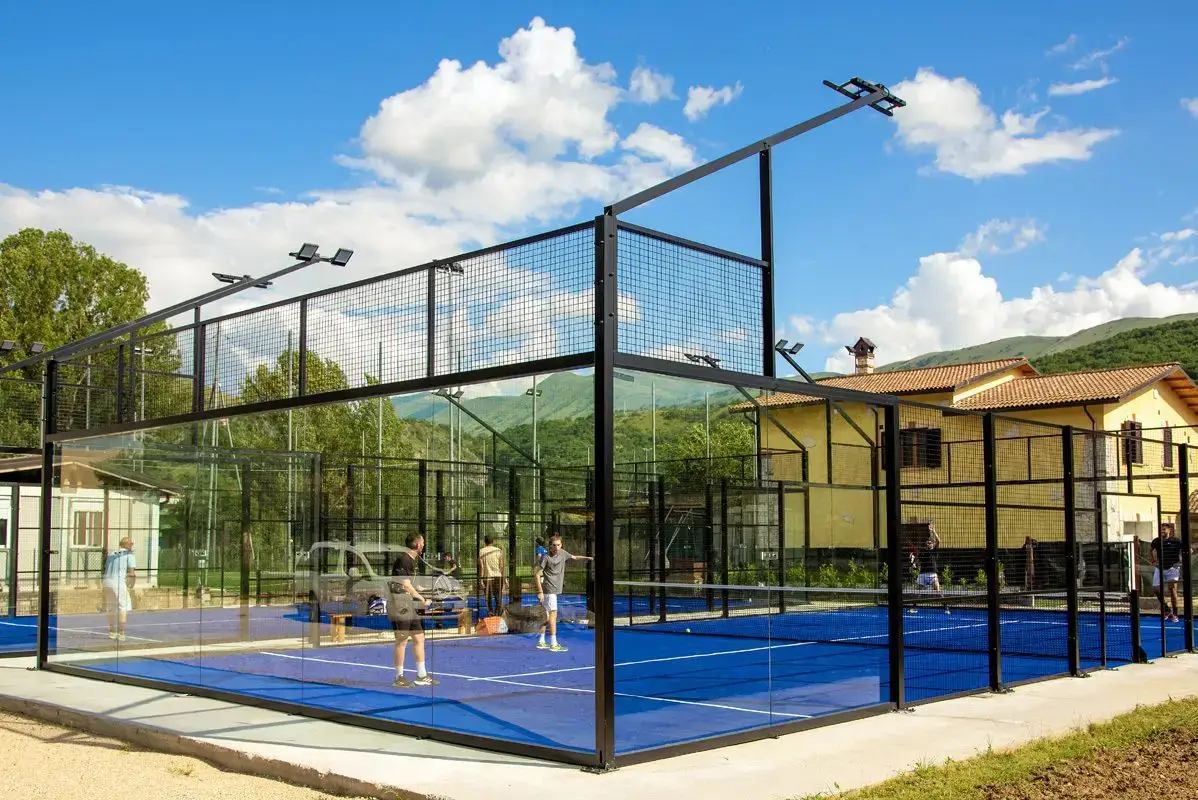
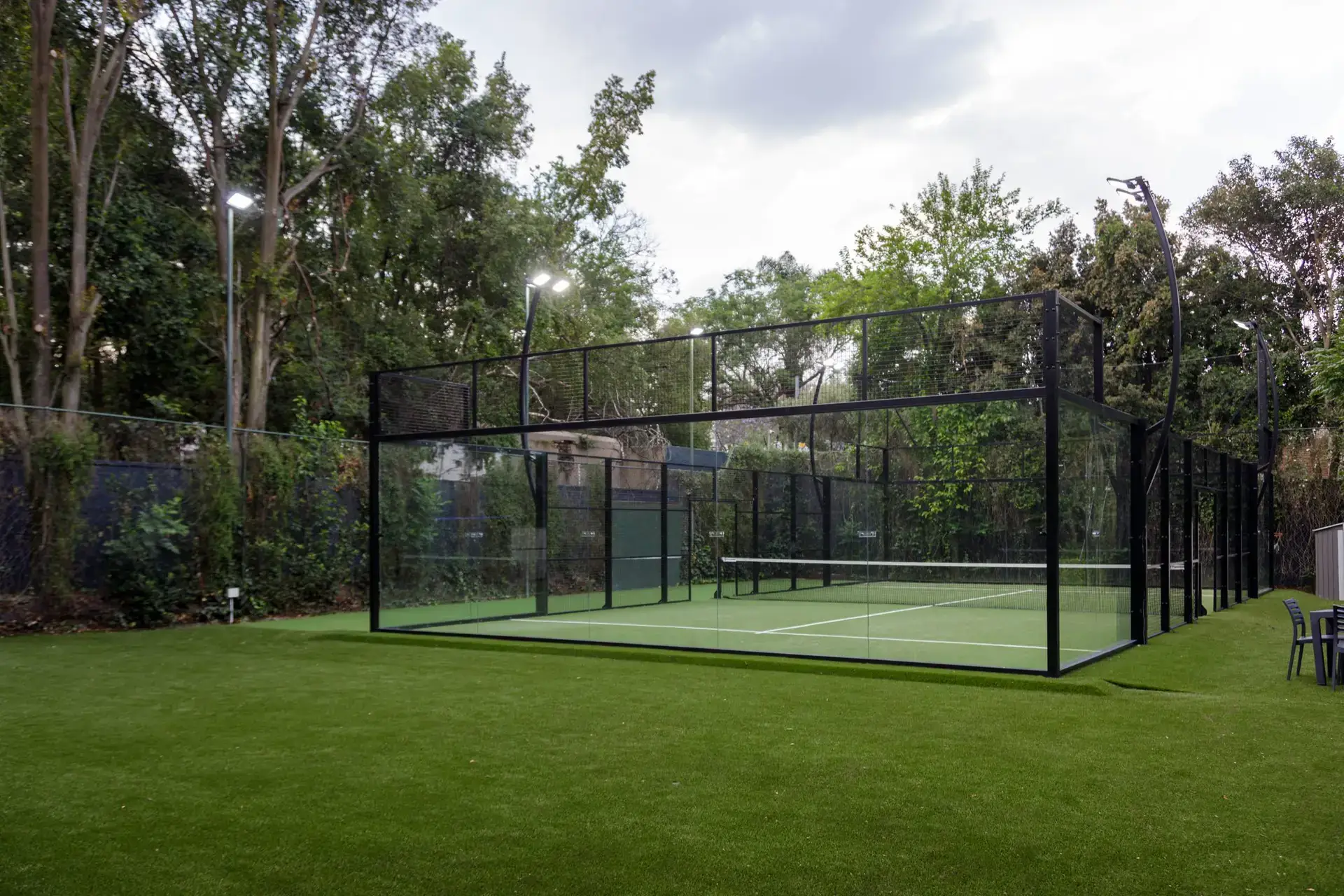
A padel court requires a steel structural frame, tempered glass panels (typically 10-12mm), galvanised mesh sections, and a specified artificial turf infill system. Lighting, drainage and a ring beam foundation all factor into the final structural specification.
Earthworks are completely dependent on the land, which needs to be surveyed along with a geotech report to test soil conditions before any concrete goes down. This is one of the most overlooked steps in padel court construction, and skipping it is how projects run into costly surprises later.
Our exclusive partnership with Padel Galis, the prestigious Spanish court supplier, allows us to bring the finest padel courts to South Africa, combining superior craftsmanship with modern design trends. Models like the Mundial 90 Panoramic and Wilson Elite are engineered specifically around these structural demands.
Tennis Court Padel Conversion: Making the Most of Existing Assets
One of the questions we field constantly is whether an old, underused tennis court can simply become a padel court. The answer is usually yes, and it is one of the smartest moves in tennis vs padel requirements planning.
Transform your existing tennis court into a premium padel court without the full site prep burden of a ground-up build. Our tennis court padel conversion process is designed for minimal downtime, whether the site is residential, commercial or a sports recreational facility.
From planning to final installation, we make the process seamless. Existing slabs, fencing footprints and drainage infrastructure can often be repurposed, which reduces both cost and construction time compared to starting from bare ground.
Surface and Turf Requirements: Padel Court Design Considerations
Tennis surfaces vary widely: hard court, clay, grass, each with distinct maintenance needs and playing characteristics. Padel, by contrast, is standardised almost entirely around artificial turf.
We offer two primary turf categories in our padel court design range: texturised turf, which favours a faster pace and consistent bounce, and monofilament turf, built for durability and high recovery in outdoor conditions.
A padel court should be more than just a playing surface. It should reflect your style, fit your environment, and enhance every match, which is why dual-colour court options and branded netting have become standard requests from clubs and estates alike.
Indoor vs Outdoor Padel Courts and Roofing Requirements
Climate is a defining factor in any tennis vs padel requirements comparison. Tennis courts are almost always left exposed, with play simply cancelled during rain.
Padel courts, particularly in the commercial and club segment, are increasingly built with a roof structure attached from day one. We offer Portal Frame, Faceted Frame and Dome Frame options depending on site aesthetics and budget, giving operators of indoor padel courts and outdoor padel courts genuine flexibility.
All-weather capability changes the entire revenue model for a facility. A roofed, floodlit court can book out every evening slot regardless of season, something an open tennis court simply cannot compete with.
Padel Court Feasibility: Testing the Investment Before You Build
At Padel Build, we do not just build courts, we build sustainable, profitable padel businesses. This is why our padel court feasibility service exists as a distinct step, well before any construction contract is signed.
The process runs through four clear stages: Discovery, Analysis, Report and Close. We model demand, pricing, NPV, IRR and payback period so stakeholders get a data-backed investment blueprint rather than a guess.
Feasibility matters just as much for conversions as new builds. Even when repurposing an existing tennis court, knowing your break-even utilisation rate before committing capital is the difference between a hobby court and a genuine asset.
Panoramic and Premium Padel Courts: Raising the Player Experience
Not every property needs the same tier of court. This is where the range within panoramic padel courts becomes relevant to your final decision.
Crafted for performance and precision, our Pro and Express Courts feature top-of-the-line construction and design, drawing on a legacy of over 10,000 courts installed globally under the Padel Galis name. The Mundial 90 Panoramic and Ultra Panoramic Special Edition are built for a fully immersive spectator experience, unlike anything traditional tennis fencing can offer.
For sites wanting flexibility without a permanent structural commitment, our FlexiPadel and Portable Kit range lets you install premium padel courts on smooth tennis courts, hard surfaces or levelled ground, ideal for temporary events or phased rollouts.
Multi-Court Padel Facility Requirements for Clubs and Estates
Because a padel court needs roughly a third of the land a tennis court requires, clubs and estates can build far more capacity on the same footprint. This is a decisive factor in tennis vs padel requirements for anyone planning a multi-court padel facility.
We have delivered exactly this across the region, from four courts at a major Johannesburg community hub to indoor championship courts paired with outdoor Mundial 90 courts at a multi-facility site. Each project also weighs in padel court pods, Mini, Midi or Maxi, for pro shops, storage and amenities that integrate visually with the courts.
Whether it’s a club padel courts project or an estate padel courts development, the same principle holds: more courts per hectare means a stronger case for return on investment than a single tennis court could ever offer.
Padel Court Maintenance vs Tennis Court Upkeep
Long-term costs are another area where tennis and padel diverge sharply. Tennis court upkeep is largely about resurfacing, line repainting and net replacement.
Padel court maintenance covers structure, glass, turf, nets and drainage, five distinct systems that each need routine inspection. Stay game ready, protect your investment, is exactly why we built a dedicated maintenance program rather than treating it as an afterthought.
Our padel court maintenance service includes routine inspections, ad-hoc repairs, and access to emergency parts, so operators are never left waiting weeks for a cracked panel or a torn net to be resolved.
Padel Court Builders Across Southern Africa: Where We Work
Padel has exploded across the country so rapidly that there are now well over a thousand padel courts nationwide, and demand shows no sign of slowing in 2026. As one of the established padel court builders working across the region, we see the different requirements each market brings.
Space is at a premium for padel courts Johannesburg projects, where estate density often makes padel’s compact footprint the only realistic option over a full tennis court. Coastal wind and salt exposure shape material choices for padel courts Cape Town and padel courts Durban builds, while inland heat and altitude factor into turf selection for padel courts Pretoria sites.
We are the padel turnkey construction team you have been searching for, and our project history across Southern Africa padel courts developments reflects that range of conditions and client types, from golf estates to schools to public sports clubs.
Our Turnkey Padel Courts Process: From Site Visit to First Serve
No matter which side of the tennis vs padel requirements decision you land on, the build process itself needs structure. We take projects from vision to reality in a structured 12-week timeline wherever site conditions allow.
Our turnkey padel courts process runs through project inception, architectural concept and planning, production and procurement, site development and civil works, and finally court installation and first serve. Land survey and soil testing happen early, alongside technical drawings and compliance checks, so surprises are minimised later in the build.
Our transparent approach ensures that you have all the information you need to proceed confidently. Every step, including glass, structure, turf and lighting, is covered by warranty at handover.
Conclusion: Choosing Between Tennis and Padel Requirements for Your Property
Weighing tennis vs padel requirements ultimately comes down to your land, your budget and your growth plan. Padel wins on space efficiency, faster build timelines through conversion, and lower long-term court-count investment per square metre, while tennis retains its place where heritage, existing infrastructure or club tradition make it the obvious choice.
Whether you’re considering a padel court for your property or weighing a full conversion, our team can walk you through the exact requirements for your site. Get in touch with us to schedule a site visit, or browse our blog and homepage for more on how we are building South Africa’s padel boom, one court at a time.
Frequently Asked Questions
Is a padel court smaller than a tennis court?
Yes, a padel court is significantly smaller, requiring around 200m² of total space compared to roughly 670m² for a full tennis court with run-off. This is one of the biggest differences in tennis vs padel requirements and why so many properties can fit multiple padel courts in the same area as one tennis court.
Can you convert a tennis court into a padel court?
Yes, tennis court padel conversion is one of the most cost-effective ways to add padel to an existing property. Depending on the site, one tennis court can often become one or two padel courts, reusing existing slabs and drainage where feasible.
Is padel or tennis a better investment for a club in 2026?
Padel generally offers a stronger return per square metre thanks to its compact footprint and shorter, faster-turnover matches. We recommend running a padel court feasibility assessment against your specific site and target market before deciding between the two.
What materials are needed to build a padel court?
A padel court requires a steel structural frame, tempered glass panels, galvanised mesh, artificial turf, drainage systems and lighting, all set on a properly surveyed and geotech-tested foundation. Tennis courts, by comparison, need only a hard surface, fencing and a net.
Do padel courts need a roof?
A roof is not mandatory, but Portal Frame, Faceted Frame and Dome Frame roofing options are increasingly common for commercial padel court roofing projects because they enable all-weather, year-round bookings. This is a major advantage over standard outdoor tennis courts, which are typically left fully exposed.
How long does it take to build a padel court in South Africa?
A standard turnkey padel court build typically takes around 12 weeks from project inception to first serve, covering design, procurement, civil works and installation. Conversions from existing tennis courts are often faster due to reduced site preparation requirements.
What does padel court maintenance involve compared to tennis courts?
Padel court maintenance covers five core systems: structure, glass, turf, nets and drainage, each requiring routine inspection and occasional ad-hoc repair. Tennis court maintenance is comparatively simpler, focused mainly on surface resurfacing and net replacement over time.